
Panacea Networking Limited
Reporting period: 1 January to 31 December 2025. Publication date: 5 September 2026. Published version 6.
Download the Carbon Reduction Plan as a PDF
- Net Zero commitment
- Boundary and methodology
- Baseline emissions
- Current emissions
- Reduction targets
- Reduction projects
- Declaration and sign-off
Commitment to achieving Net Zero
Panacea Networking Limited is committed to achieving Net Zero greenhouse gas emissions by 2050.
Reporting boundary and methodology
Boundary approach: operational control
Panacea Networking Limited maintains a registered office and operates a dedicated technical base supporting lab, networking, infrastructure and administrative activity; the registered office and the technical base are not the same location. The wider workforce operates primarily on a remote-first basis, attending customer sites and the technical base where operationally required. The reporting boundary includes business activities under Panacea’s operational control, including business-owned IT and networking equipment, attributable electricity consumption used to support business operations, electricity used to charge the company-owned battery-electric vehicle where attributable to business activity, business travel, waste generated in operations, and relevant upstream and downstream transportation and distribution associated with customer equipment supplied through distribution partners. Panacea has no company-owned or leased petrol/diesel vehicles, no gas, LPG or oil heating, no generator fuel and no other direct fossil-fuel combustion sources. Where electricity used by the technical base is shared with domestic premises and cannot be separately metered, Panacea estimates the business-attributable share using documented equipment power ratings, operating-hour assumptions and other available activity data; shared domestic electricity unrelated to Panacea is excluded. Customer equipment is purchased through established distribution partners who arrange delivery; those transport activities are assessed within Scope 3 where relevant.
Distributor-arranged freight purchased by Panacea Networking Limited, including direct-to-customer deliveries, is reported in Scope 3 Category 4, Upstream Transportation and Distribution. No separate Scope 3 Category 9, Downstream Transportation and Distribution activity has been identified for the reporting period; it is therefore reported as not applicable at 0.000 tCO₂e.
Conversion factors: UK Government GHG Conversion Factors for Company Reporting 2025, 2025.
Source: UK Government conversion factors for company reporting 2025.
Baseline emissions footprint
Baseline period: 1 January to 31 December 2025
| Category | Scope | Status | tCO₂e |
|---|---|---|---|
| Scope 1 emissions | Scope 1 | Not Applicable | 0.000 |
| Scope 2 emissions | Scope 2 | Estimated | 2.581 |
| Upstream transportation and distribution | Scope 3 | Estimated | 0.010 |
| Waste generated in operations | Scope 3 | Estimated | 0.000 |
| Business travel | Scope 3 | Estimated | 8.565 |
| Employee commuting | Scope 3 | Estimated | 0.694 |
| Downstream transportation and distribution | Scope 3 | Not Applicable | 0.000 |
| Total | 11.850 | ||
| Scope 1 subtotal | 0.000 | ||
| Scope 2 subtotal | 2.581 | ||
| Scope 3 subtotal | 9.269 |
Per-line calculation methodology and evidence references are set out in the accompanying Supporting Methodology & Evidence Report.
Current emissions reporting
| Category | Scope | Status | tCO₂e |
|---|---|---|---|
| Scope 1 emissions | Scope 1 | Not Applicable | 0.000 |
| Scope 2 emissions | Scope 2 | Estimated | 2.581 |
| Upstream transportation and distribution | Scope 3 | Estimated | 0.010 |
| Waste generated in operations | Scope 3 | Estimated | 0.000 |
| Business travel | Scope 3 | Estimated | 8.565 |
| Employee commuting | Scope 3 | Estimated | 0.694 |
| Downstream transportation and distribution | Scope 3 | Not Applicable | 0.000 |
| Total | 11.850 | ||
| Scope 1 subtotal | 0.000 | ||
| Scope 2 subtotal | 2.581 | ||
| Scope 3 subtotal | 9.269 |
2025 is both the first formal baseline year and the first reporting year. The current emissions footprint is identical to the baseline footprint set out in Section 03 (11.850 tCO₂e). No year-on-year reduction is reported for the baseline year. Future annual Carbon Reduction Plans will compare the latest reporting year against this fixed 2025 baseline.
Emissions reduction targets
Panacea Networking Limited has set its own interim target to reduce gross greenhouse gas emissions by at least 25% by 2030 against the 2025 baseline. This equates to reducing total emissions from 11.850 tCO₂e to no more than approximately 8.89 tCO₂e by 2030.
This is an organisational target set by Panacea Networking Limited. It is subject to business growth and to annual refinement of activity data and conversion factors. All figures are gross emissions reported before any offsetting; offsets are not netted against the reported Scope 1, 2 or 3 footprint. Progress towards this target sits alongside the commitment to Net Zero by 2050.
Progress against organisational targets
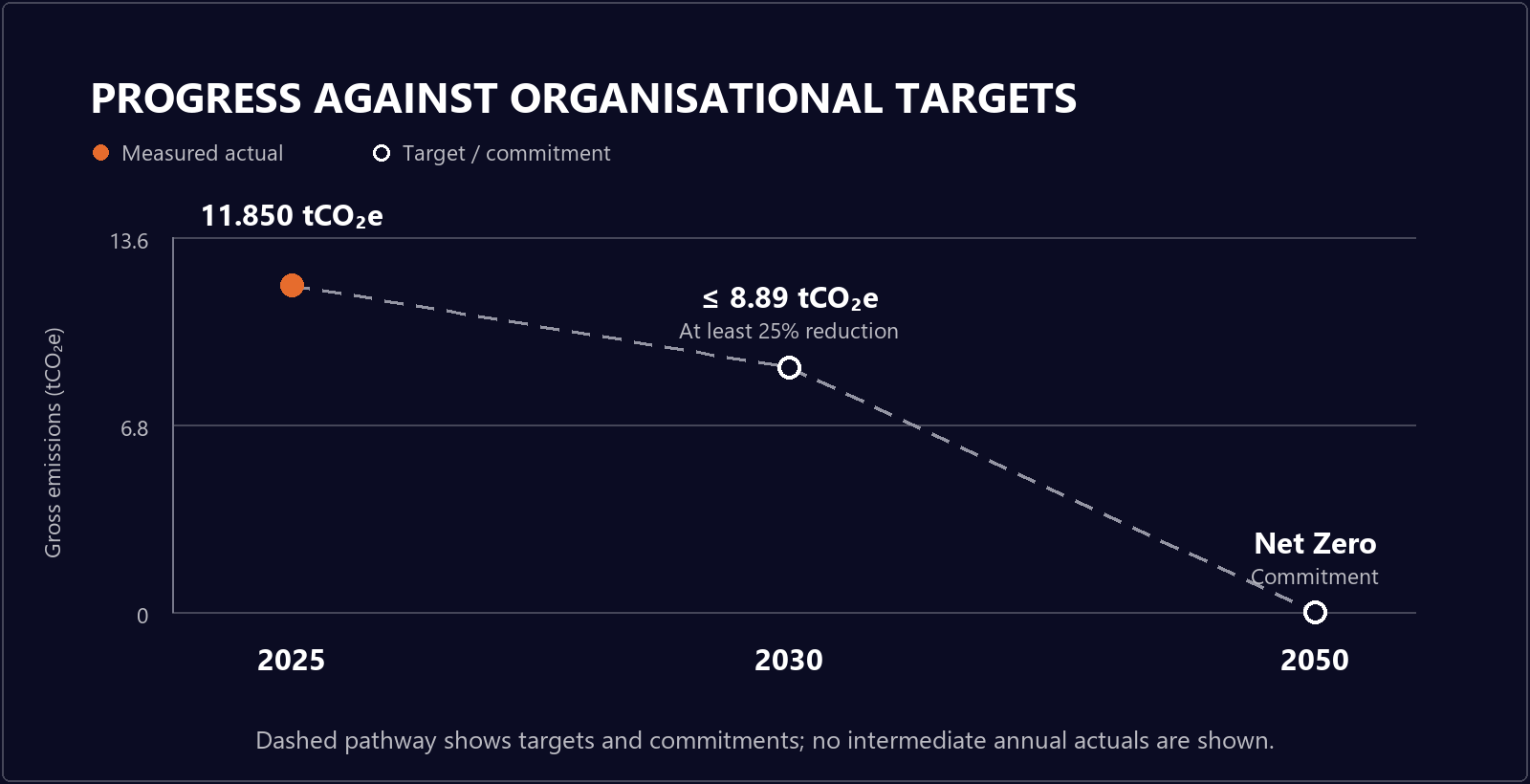
| Year | Actual or target | Status |
|---|---|---|
| 2025 | 11.850 tCO₂e | Measured actual and baseline |
| 2030 | ≤ 8.89 tCO₂e | Target: at least 25% reduction |
| 2050 | Net Zero | Commitment |
The pathway between these points represents targets and commitments only; no intermediate annual actuals are shown.
Carbon reduction projects
Completed environmental management measures described below are in effect, and ongoing measures are being implemented as stated. These measures will be applied where relevant when performing contracts awarded under the framework. Planned measures are prospective and will apply only once implemented and where relevant to the contract; they are not represented as currently operational.
Completed measures
Verified as delivered. Savings shown are realised.
LED lighting and energy efficiency
Panacea has implemented energy-efficient LED lighting across the business areas under its operational control. This supports lower electricity demand alongside the company’s distributed-working model. No quantified carbon saving is claimed unless independently calculated from evidenced consumption data.
Scope 2 · from 2022
Network equipment power optimisation
Panacea applies network equipment consolidation and power-efficiency practices, including optimisation of PoE/network infrastructure where practical, to reduce unnecessary electricity consumption across internal networking and lab equipment.
Scope 2 · from 2022
ISO 14001:2015 certified Environmental Management System
Panacea Networking Limited operates an Environmental Management System independently certified to ISO 14001:2015 by Citation ISO Certification Limited. Certificate scope: IT network consultancy, design, support and implementation services, including Extreme Networks solutions, serving the healthcare, government and legal sectors. Original approval 10/03/2025; current certificate issued 10/03/2026; expiry 09/03/2029. The EMS provides the governance framework for monitoring, reviewing and improving the measures in this plan. No emissions saving is claimed for the certification itself.
Cross-cutting · from 2025
Battery-electric company vehicle
Panacea uses a fully battery-electric company-owned vehicle rather than a petrol or diesel company vehicle. This eliminates direct tailpipe combustion emissions from the company vehicle. Electricity used for attributable business charging is assessed separately within the electricity footprint.
Scope 1 · from 2025
Ongoing measures
In progress. Savings shown are expected annual figures, not yet fully realised.
Client carbon and energy efficiency advisory
Panacea incorporates energy efficiency and technology optimisation into relevant client advisory and network design activity, helping customers consider lower-energy infrastructure choices and more efficient operating models. Any customer carbon savings are reported separately and are not netted against Panacea’s own footprint.
Scope 3 · from 2022
Remote diagnostics and support
Panacea uses remote diagnostics, remote support and digitally enabled service delivery to avoid unnecessary customer-site visits where work can be completed effectively without travel.
Scope 3 · from 2022
Hardware reuse, refurbishment and responsible disposal
Panacea seeks to extend useful equipment life through reuse and refurbishment where practical and routes redundant electronic equipment through responsible WEEE/e-waste channels. Customer-owned networking equipment is generally managed by the customer.
Scope 3 · from 2023
Cloud infrastructure migration and optimisation
Panacea continues to move suitable internal systems and services toward cloud infrastructure and providers with stronger environmental and energy-efficiency credentials, reducing reliance on additional on-premises compute where appropriate.
Scope 2 · from 2023
Sustainable vendor selection
Panacea considers supplier and manufacturer environmental credentials when selecting strategic vendors and technology partners, including recognised environmental-management or decarbonisation commitments where relevant to procurement decisions.
Scope 3 · from 2023
Paper reuse and responsible e-waste route
Waste paper generated through business activity is shredded and reused rather than entering a commercial disposal stream. Electronic waste is routed through Currys’ official free e-waste/WEEE service. No quantified carbon saving is claimed until waste quantities and an appropriate methodology are documented.
Scope 3 · from 2025
Distributed remote-working operating model
Panacea operates a distributed, remote-first workforce supported by a registered office and operational technical base for lab, infrastructure, systems and administrative activity. This model reduces routine commuting and avoids unnecessary reliance on a large centralised office estate while maintaining a stable technical base for service delivery. No quantified carbon saving is claimed until a documented calculation is available.
Cross-cutting · from 2025
Planned measures
Future measures. Any figures shown are potential and unverified.
Solar energy feasibility
Panacea is assessing the feasibility of using on-site solar generation or other appropriate renewable-electricity options to reduce the grid electricity associated with business operations. Any project will be assessed for technical suitability, cost effectiveness and measurable carbon benefit before implementation.
Scope 2 · from 2025
UK carbon offset and tree-planting initiative
Panacea intends to explore a credible UK-based tree-planting or carbon-offsetting initiative for residual emissions after prioritising direct operational reductions. Any offsets used will be additional to, and will not replace, gross Scope 1, Scope 2 or Scope 3 emissions reporting.
Cross-cutting · from 2025
Declaration and sign-off
This Carbon Reduction Plan has been completed in accordance with the current PPN 006 technical standard and associated guidance. Emissions have been reported and recorded in accordance with the published reporting standard for Carbon Reduction Plans and the GHG Reporting Protocol Corporate Standard, using an appropriate UK Government conversion factor dataset for greenhouse gas company reporting. Scope 1 and Scope 2 emissions have been reported in accordance with SECR requirements where applicable, and the mandated Scope 3 categories have been reported in accordance with the GHG Protocol Corporate Value Chain (Scope 3) Standard. This Carbon Reduction Plan has been reviewed and signed off by the board of directors, or equivalent management body, and will be reviewed and published annually.
| Board or equivalent approval | Approved 2026-09-05 |
| Signed (director or equivalent) | Martin Flammia |
| Job title | Director |
| Date | 2026-09-05 |
Published version 6 · Original PDF generated 24 September 2026.